Mérida is a great city for walkers, but it also seems determined to keep a retired Canadian grandma on her toes.
One block gives you a wall painted in pink, blue, yellow, or green so bright it almost feels wet in the sun. The next block gives you a cracked sidewalk, a missing chunk of curb, or a bundle of electrical wires hanging low enough to make you stop and stare and mutter, “Well, that can’t be up to code.” A polished new building can sit beside a house that looks one rainy season away from giving up. That is Mérida. Beautiful, confusing, hot, and full of contrast—and yes, I really do like it here.
I’ve always loved walking cities. Walking lets me understand a place in a way taxis never do. You notice when the city wakes up. You hear the dogs, the buses, the vendors, the church bells, the music from an open door. You smell breakfast, exhaust, rain on warm pavement, and food cooking somewhere close by. You learn the rhythm, the same way you learn how to walk on icy sidewalks back home without landing on your backside.
But in Mérida, I had to change my rhythm—just like when I traded snow boots for sandals and a to-do list for a pension.
Walking here can feel like an Olympic sport for senior citizens. The heat slows you down. The sidewalks demand attention. The traffic keeps you alert. A 10 km day is not just a walk. It is an achievement, the kind that absolutely deserves a cold drink and maybe a nap.
So I created my own walking method. I call it the Plaza Hop, and no, it does not involve actual hopping—my knees already filed a protest in 1998.
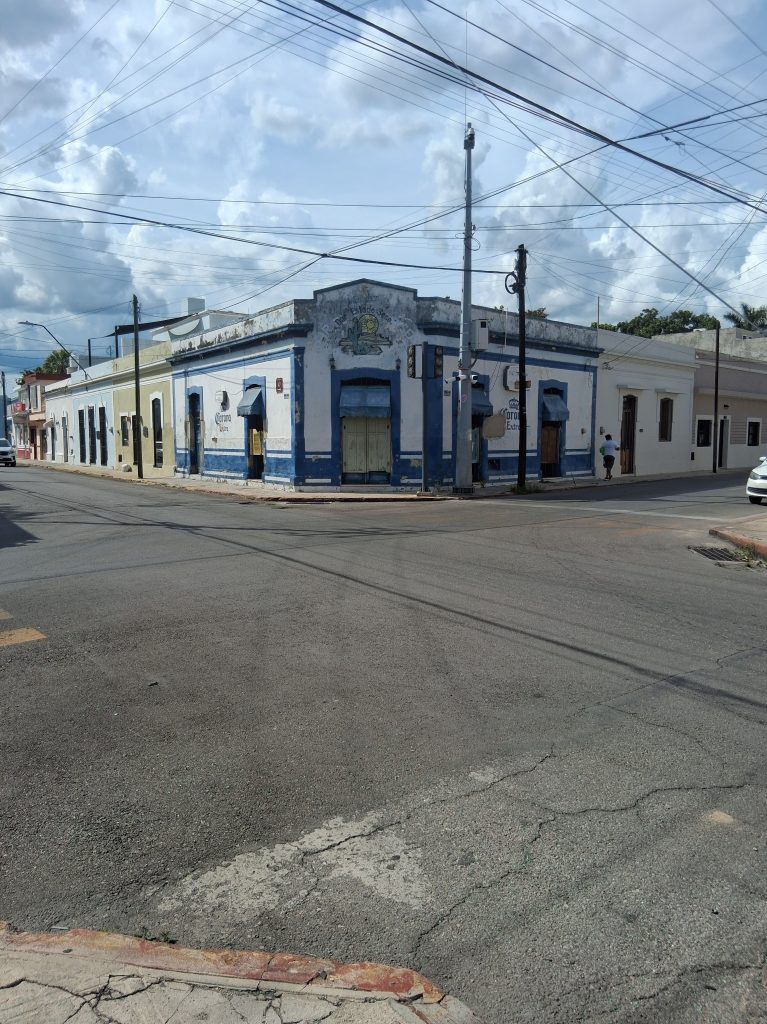
Mérida can change character from one doorway to the next.
Mérida is not a polished postcard city, at least not all the time. That is part of what makes it interesting and why I keep wandering around with my jaw slightly open.
There are streets where the colors stop you. A deep red wall. A turquoise door. A yellow house glowing in the sun. A purple facade that looks like someone chose joy on purpose. Then, right beside it, there might be a building with peeling paint, broken stone, or a roofline that has clearly seen better decades.
The contrast is constant, like going from February in Montreal to a beach vacation in one plane ride.
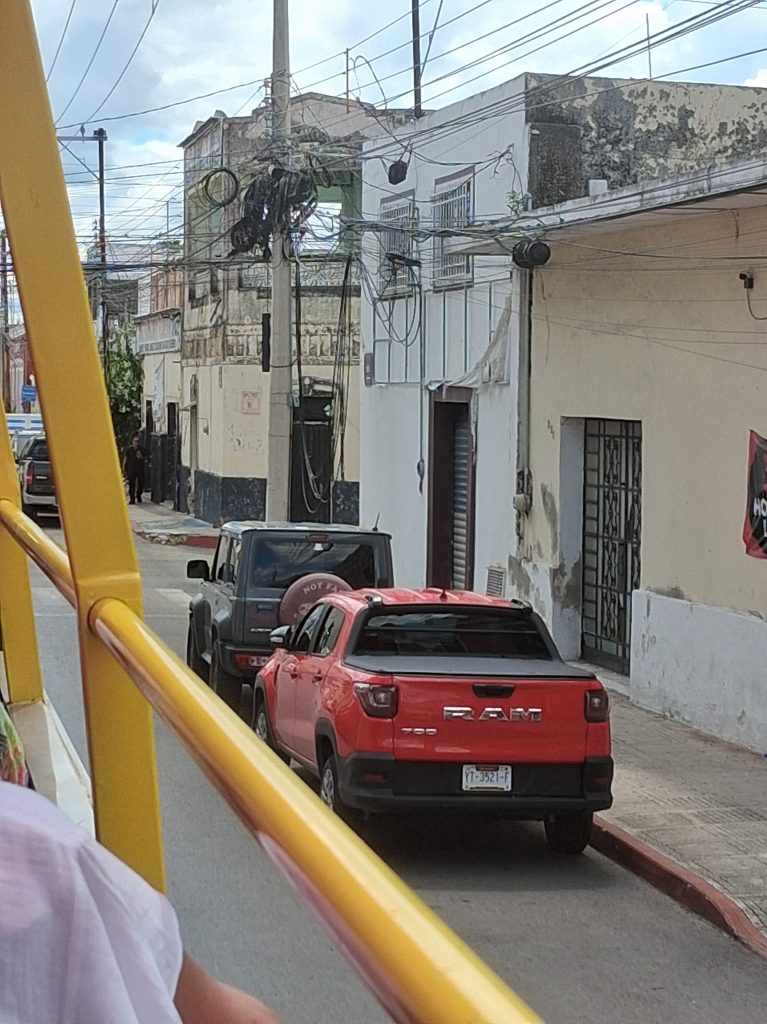
Old and new sit beside each other without apology. A restored boutique hotel might be next to a crumbling house. A clean modern storefront might face a sidewalk with a sudden drop. A beautifully painted wall might have exposed electrical wiring nearby. Sometimes there are wires poking from the ground, wires lying in the street, or wires hanging low from poles, like someone let a toddler design the power grid.
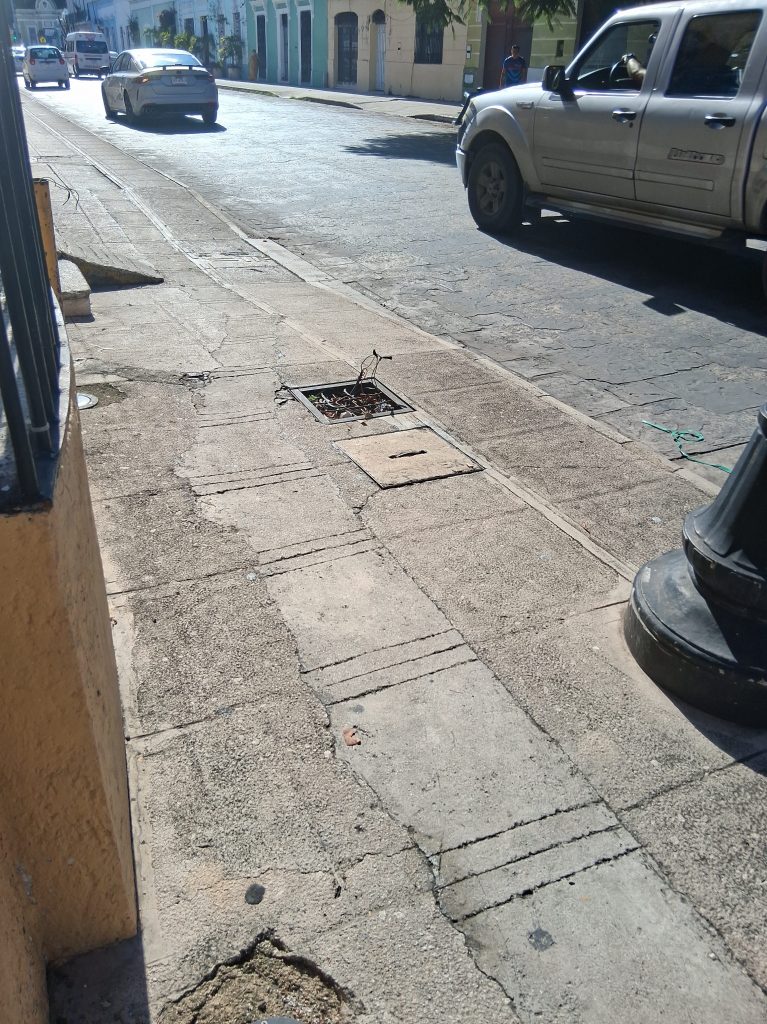
That last part is not just visual clutter. It can feel dangerous, especially when it rains. Mérida has power outages often enough that you start noticing the electrical system. Then you look up and see rolls and rolls of wires on utility poles. It does not exactly inspire confidence, but somehow the city keeps buzzing along—literally and figuratively.
Still, the city keeps moving, and so do I, one careful step at a time.
People sweep sidewalks in the morning. Doors open. Buses groan past. Motorbikes slide through traffic. Someone is selling something from a cart. Someone else is repainting a wall the color of a tropical fruit. Mérida, Mexico, is not simple. It is bright and worn, graceful and messy, generous and difficult, often on the same street—and it is absolutely alive.
That contrast is the city’s personality, and I am learning to like it just the way it is.
I usually walk fast. In many cities, I can put on comfortable shoes, choose a direction, and disappear for hours. Mérida forced me to slow down, which, to be honest, is probably good for a newly retired 64-year-old who still hasn’t quite found the brake pedal.
The sidewalks are the first reason.
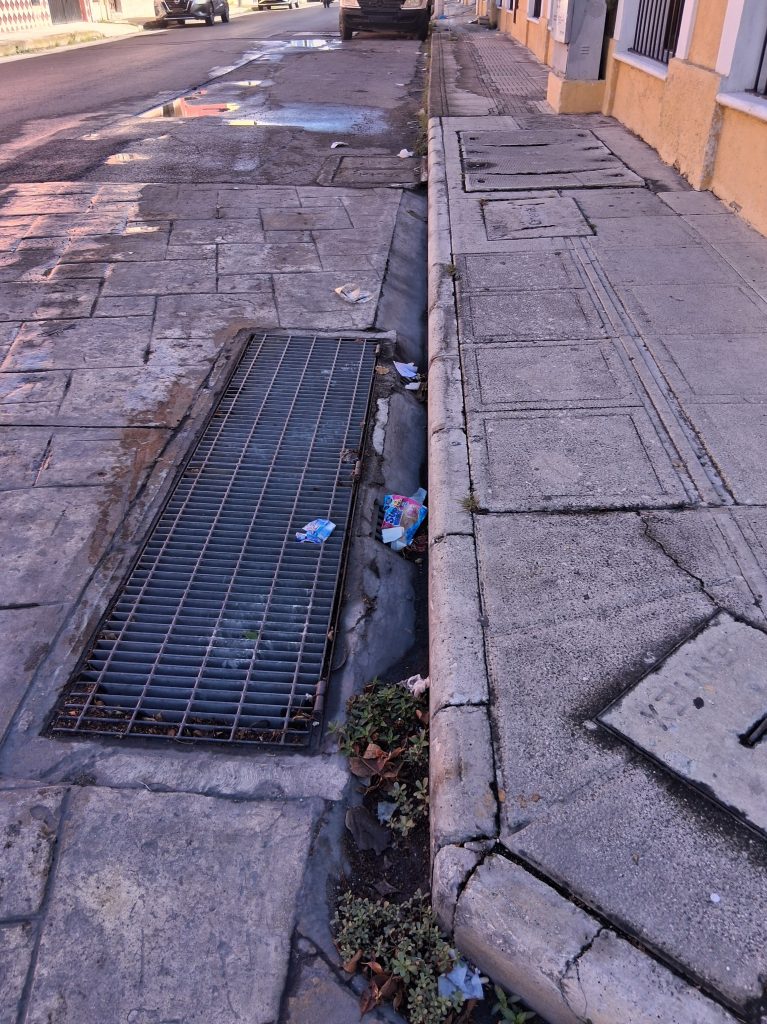
Some are narrow. Some are broken. Some tilt in odd directions. Some rise a few centimetres, then suddenly jump much higher. In places, the curb or sidewalk can feel like a step built for giants, sometimes close to 45 cm. You cannot just look around and drift. You have to watch your feet, the way you would watch for black ice in the middle of winter in Canada.
Potholes are common. Uneven pavement is common. Sudden holes, loose stones, and surprise drops are part of the walk. If you enjoy taking photos, this creates a funny problem. The city keeps giving you things to look at, but the ground keeps demanding your full attention. My camera is full of half-framed doors and various artistic shots of my own shoes and legs.
Then there is the heat.
Mérida is hot in a way that changes the way you plan your day. Morning is precious. Shade is valuable. A bench can feel like luxury. By midday, the city can become loud, bright, and heavy. The sun bounces off walls and streets. Even short distances can feel longer than they look on a map, especially when your internal thermostat is calibrated for Canadian fall.
Traffic adds another layer.
Drivers can move quickly and pass close. As a pedestrian, do not assume a car will stop. It will not. Before crossing, look both ways. When you start crossing, look again. Stay back from the curb while waiting. Give yourself space. In many situations, cars act as if they have priority, so walking with caution is not optional—no matter how confident you feel after forty-odd winters of driving on snow.
This does not mean Mérida is unwalkable. It means Mérida asks for a different kind of walking, especially from a retired Canadian who used to think a long walk on the Ottawa River pathway was a big adventure.
Less rushing. More looking. More planning. More respect for the street—and a lot more water.
The Plaza Hop makes the city easier to walk
The Plaza Hop started as a survival strategy and has now become my unofficial retirement fitness program.
Before I leave my Airbnb in the morning, I decide what I need to do and where I need to go. Maybe I want a cacao drink made with coconut water and infused with coffee. Maybe I need groceries. Maybe I want to visit a church, a market, a museum, or a specific neighborhood. Instead of choosing the most direct route, I look for plazas along the way, like a squirrel planning nut stops.
The goal is simple: hop from plaza to plaza until I reach my destination.
This changes everything.
A straight 4 km walk in Mérida heat can become tiring fast. A 4 km walk broken into smaller sections with shade, benches, people-watching, and phone charging becomes much more enjoyable—and far less likely to end with me melting into a small Canadian puddle.
Most plazas offer at least some of what a walker needs:
- Shade from trees or nearby buildings
- Benches where you can rest
- A place to pause without blocking the sidewalk
- Free Wi-Fi in many central areas
- Electrical outlets in many plazas
- A chance to watch daily life unfold
That last point matters most.
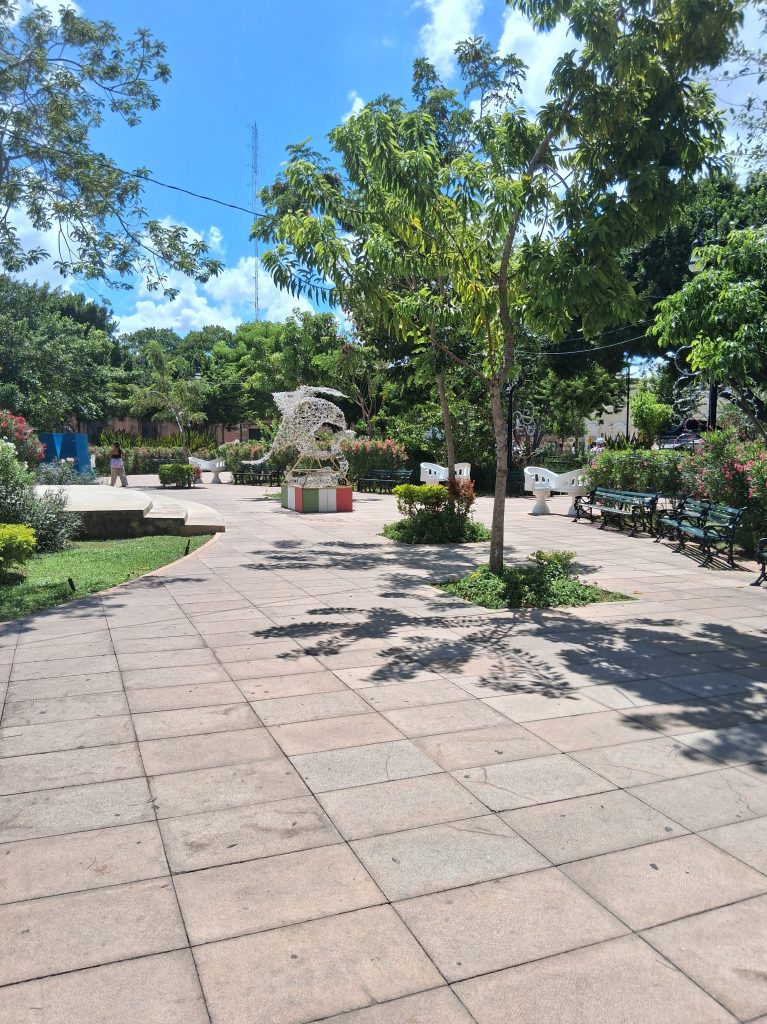
Plazas are not empty decorations in Mérida. People use them. People meet there, rest there, eat there, sing there, preach there, wait there, and watch the day pass. A plaza can feel quiet in the morning, busy by noon, and completely different at night, like it changed outfits while you were gone.
With the Plaza Hop, walking becomes less about covering distance and more about reading the city in chapters.
You walk a section. You stop. You cool down. You drink water. You pour water on yourself. You charge your phone if you need to because you did bring the charger that you bought at the airport for $60. You look around. Then you move again. Repeat until satisfied, or until you decide it’s time for ice cream.
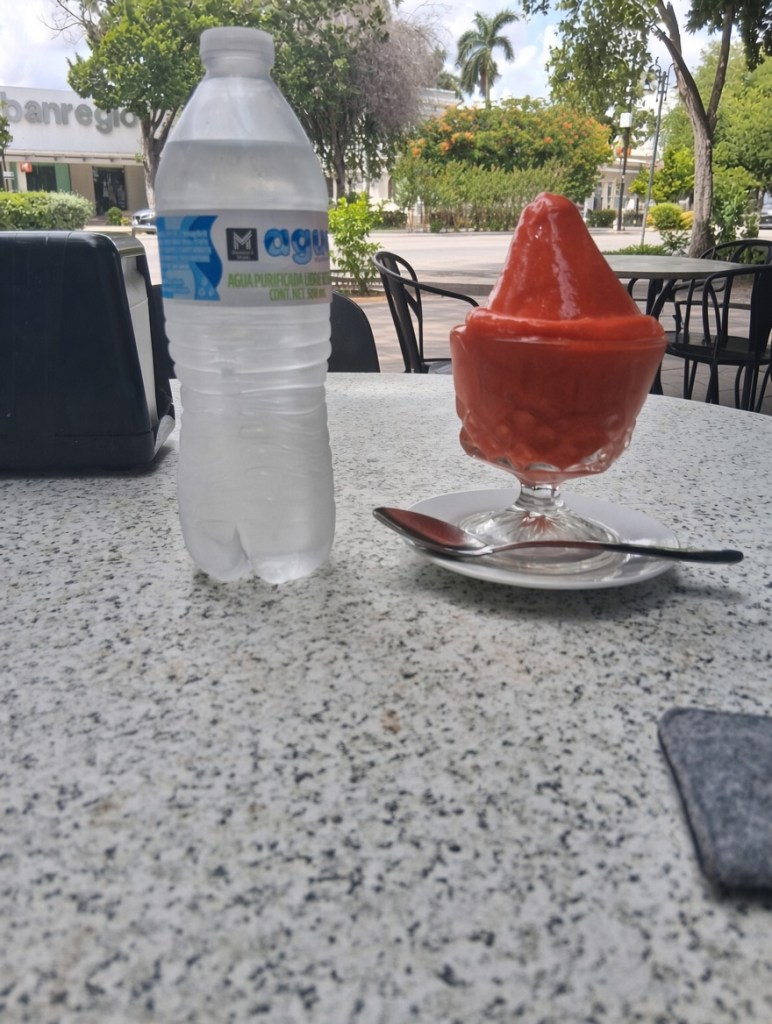
It sounds simple because it is. But in a hot city with uneven sidewalks and intense street life, simple systems help, especially when you are old enough to get the seniors’ discount but still stubborn enough to walk everywhere.
How I plan a Plaza Hop walk
I do not overplan. That would ruin the pleasure of walking. I only create enough structure to stay comfortable and safe—and to reassure my kids that I haven’t lost my mind yet and I’m not just wandering around in 35°C with no water and a dead phone.
Here is the basic method.
Choose the main goal
I start with one clear destination. It might be a market, a restaurant, a park, or an area I want to photograph. This keeps the walk from turning into a hot, wandering mistake, which I might have called “adventure” in my 20s but now would just call “bad planning.”
Check the distance
If the route is longer than it looks, I break it into pieces. In Mérida, distance on a map does not tell the full story. Heat, traffic, and sidewalks all add effort, and my retired legs like to be consulted about these things.
Find plazas along the way
I look for parks and plazas that sit between my starting point and my destination. They become my rest stops, my shade stations, and my unofficial field study sites for “Everyday Life in Mérida, as Observed by One Curious Canadian.”
Leave early when possible
Morning walking feels better. The city is waking up, the light is softer, and the heat has not fully taken over. It feels a bit like those quiet early mornings in the Kawarthas, if the region also had honking buses and someone selling tamales.
Carry water
This is not optional. Even if a route looks easy, the heat can catch up quickly. I carry more water here than I ever did during a full day of errands at home.
Wear shoes that can handle bad pavement
Pretty sandals might look right for the city, but Mérida sidewalks do not care. Comfortable shoes with good soles make a real difference—and they make it much less likely that I will be phoning anyone to explain a twisted ankle in my paradise vacation.
Keep the phone charged
Because plazas often have outlets and Wi-Fi, I use the stops to check maps, send messages, and recharge if needed. It is very comforting to know I can always look up where I am and send proof-of-life photos to the family group chat.
The Plaza Hop is not about avoiding the city. It is about getting more from it. I still walk. I still explore. I still take the long way when something catches my eye. I just give myself places to land, cool down, and appreciate the chaos without overheating.
Plazas show the real rhythm of Mérida
The best part of the Plaza Hop is not the rest. It is the observation.
When you sit in a plaza, Mérida starts performing its ordinary life, and you have a front-row seat—no ticket required.
Someone walks through with groceries. Someone sits alone and feeds pigeons. A couple talks on a bench. A musician appears. A preacher speaks to whoever will listen. Children cycle across the open space. Older people sit like they have claimed the same bench for years. Vendors pass by. Friends greet each other. A tourist looks lost, then pretends not to be. It’s better than Netflix and doesn’t require a subscription.
Nothing dramatic has to happen. The point is the pattern.
Every plaza has its own mood. Some feel grand and formal. Some feel local and everyday. Some are full of movement. Some feel sleepy until the evening. If you only walk through them quickly, they seem like pretty squares. If you sit for 20 minutes, they become living rooms, and you start to feel like you live in the neighbourhood too.
That is one of the things I love about Mérida. Public life still feels public. People do not only pass through plazas. They inhabit them, the way Canadians inhabit patios the second the snow melts.
This is also why the Plaza Hop works better than simply taking breaks in cafes. Cafes are useful, of course, especially when the heat gets serious. But plazas keep you inside the life of the city. You are resting, but you are still watching, listening, and learning.
You hear how loud the city gets around noon. You feel when the morning softness disappears. You notice who uses the shade and where. You learn which streets feel comfortable and which ones you would rather avoid next time.
A plaza is a rest stop, but it is also a classroom—and I seem to have enrolled myself in a very sunny retirement course.
The city asks you to slow down
Mérida has made me walk differently.
At first, that felt frustrating. I wanted my usual pace. I wanted to cover ground. I wanted long, easy walks where I could look up, take photos, and let my mind wander. Mérida did not allow that, at least not without consequences like wobbly legs, a very red face and my heart beating like it would jump out of my chest.
So I adjusted.
Now I walk with more attention. I scan the sidewalk. I stay back from the street. I cross carefully. I avoid long midday walks when I can. I stop more often. I sit more often. I look more often. In other words, I am finally practicing what all the wellness articles have been shouting about: slow down and pay attention.
And because of that, I think I see more.
The imperfections are impossible to miss. The broken sidewalks, the exposed wires, the power outages, the potholes, the decaying buildings, the intense traffic, all of it is real. It should not be romanticized. Some of it is inconvenient. Some of it is unsafe. I pay attention, I stay cautious, and I do not pretend everything is perfect.
But the beauty is real too.
The colors. The plazas. The music. The old facades. The people gathering outside. The feeling that life spills into public space. The way one block can look tired and the next can glow. It is messy and lovely at the same time, a bit like all of us by the time we hit our sixties.
Mérida is not a city to rush through with your eyes closed. It is a city to walk carefully, slowly, and with a plan—and maybe a hat, sunscreen, and a backup bottle of water.
The takeaway from walking Mérida
If you love walking, Mérida can be rewarding. It can also test your patience, your ankles, and your ability to handle heat, even if you once prided yourself on surviving minus-30 winters.
Do not treat a 10 km day here like a casual stroll. Plan it. Start early. Wear proper shoes. Watch every step. Respect the traffic. Carry water. Use the plazas. And if you are my family reading this: yes, I am doing all of those things.
The Plaza Hop has become my way of meeting Mérida on its own terms. It lets me keep walking without pretending the city is easier than it is. It gives me shade, rest, phone charging, Wi-Fi, and small windows into everyday life—all the ingredients for a surprisingly good retired-on-a-whim adventure.
Public transport in Mérida is also very good, and that deserves its own post. For now, my best advice is simple: if you want to walk Mérida, do not just map the destination. Map the pauses, plan the plazas, and give yourself permission to sit and simply be there.
That is where the city starts to make sense—and where this 64-year-old Canadian feels very much okay.


Leave a comment